
What Is a Solar Fence? The Complete Beginner's Guide


Picture this: you’re standing in your backyard, frustrated by two separate problems at the same time. The privacy fence you’ve been meaning to replace is looking worse every year, weathered, leaning, and frankly, a bit of an eyesore. At the same time, your electric bill keeps climbing. You’ve looked into solar, but your roof is too shaded by those beautiful oak trees, or perhaps it’s the wrong angle, or maybe you just don't want to bolt heavy equipment onto your brand-new shingles.
What if I told you there’s one structure that solves both problems at once?
This isn't a renovation fantasy. It’s a solar fence, and it’s exactly what it sounds like: a fence that generates electricity. While most homeowners assume solar has to live on a rooftop, a quiet revolution is happening at ground level, or rather, fence level.
Let’s walk through exactly what a solar fence is, how it works, and why this might be the most transformative upgrade you ever make for your home.
So... What Exactly Is a Solar Fence?
Here’s the simplest way to think about it: a solar fence is just rooftop solar, turned vertical with an additional panel on the back.
That’s it. Same core technology, different orientation and bifacial panels. Instead of panels lying flat on your roof, they stand upright in a fence line, typically 6 feet tall, running along your property boundary just like a privacy fence would.
It looks like a modern privacy fence. A really sharp, contemporary one, actually. But behind (and in front of) those sleek panels, something incredible is happening: your fence is harvesting energy.
Think of it like the difference between a regular car and a hybrid. Both get you from A to B. But one of them is quietly doing extra work the whole time to save you money. Your traditional wood fence just sits there, slowly rotting. A solar privacy fence sits there and generates thousands of kilowatt-hours of clean electricity every year. The science is clear. The technology is proven. The savings are real.
The Problem with "Just Put It on the Roof"
Rooftop solar is a fantastic tool, if your roof cooperates. But for millions of homeowners, the roof is a dealbreaker.
Maybe your home faces the wrong direction. Maybe you’ve got big trees providing shade you don’t want to lose. Maybe your HOA has strict restrictions on visible rooftop equipment. Or maybe you’re like many of our customers who simply realize that rooftop solar isn’t the only option.
A solar fence sidesteps every one of those hurdles. There are no roof penetrations to worry about, no roof warranty to be voided, and far fewer HOA battles. The fence goes where fences go, along your property line, and starts doing its job quietly and effectively. You can now take control of your energy production without compromising your home's structural integrity.
How Does a Solar Fence Work?
The Basics: Capturing Sunlight as Electricity
This works the same way any solar panel does. Sunlight hits the panel, knocks electrons loose inside the photovoltaic (PV) cells, and that movement of electrons becomes direct current (DC) electricity. An inverter then converts it to the alternating current (AC) your home uses to run your coffee maker, your AC, and your TV.
The interesting part is how a vertical fence captures that sunlight, and why vertical actually has some massive advantages over traditional flat panels.
The Power of Vertical Bifacial Solar
At SOL Fence®, we use bifacial solar panels. "Bifacial" is just a fancy way of saying the panels have solar cells on both sides, front and back.
The front face captures direct sunlight as it hits the panel. The back face captures reflected light, sunlight bouncing off the ground, your patio, gravel, or even snow. It’s like having a bonus solar panel built right into the back of your main one. Imagine a sunbather who could get a tan from the sun above and the reflection from the sand below at the same time. That’s exactly what these panels do. You can dive deeper into the science of two-sided sunshine collection here.
Why Vertical is Often Better than Flat
Here’s a groundbreaking discovery that surprises most people: a solar angled rooftop panel peaks at midday, when the sun is directly overhead. That’s great for the panels, but it’s often not when your home actually needs the most electricity.
A vertical fence panel facing east in the morning and west in the afternoon creates a "shoulders" production curve. It produces energy earlier in the morning and later in the evening. In the energy world, we call this "time-shifting." It is incredibly valuable because electricity demand (and often utility pricing) is highest when people are actually home, cooking dinner and running appliances. Your rooftop panels are cranking at noon when you’re at work; your SOL Fence is producing when you’re actually there to use it.
Cooler Panels = More Efficient Panels
Solar panels actually get less efficient as they heat up. It sounds counterintuitive, but it's true. A rooftop panel lying at a solar angle in the July heat can reach 140°F, causing its efficiency to plummet.
A vertical fence panel, however, has natural airflow on both sides. Wind passes around and behind it freely. Because of this, our panels run approximately 50% cooler than rooftop installations. It’s the difference between running a marathon in a heavy winter jacket versus a breathable t-shirt. The effort is the same, but the vertical setup lets the technology perform significantly better for longer.
Less Dirt, Less Maintenance
Rooftop panels are magnets for dust, pollen, and bird droppings because of their angle. A vertical panel sheds that material naturally. Rain washes it clean, and gravity does the rest. You won’t find yourself climbing a ladder to scrub your fence. Furthermore, research has shown that vertical panels shine in the snow season because snow simply can't pile up on them like it does on a roof.
What Does it Actually Look Like?
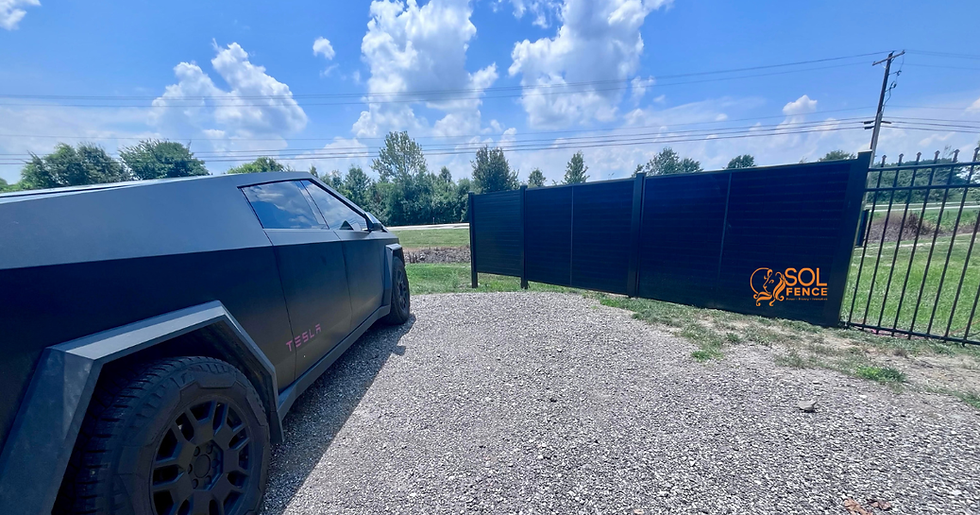
Imagine a modern, high-end privacy fence with clean lines and a contemporary aesthetic. Now imagine the slats are sleek, dark bifacial solar panels.
Our installations typically run 6 feet tall and are built to look intentional, not industrial. There are no tangled wires as you often see with rooftop installations. It’s a clean, professional fence line that happens to be an energy-generating asset. We’ve flipped solar on its side, literally, and that’s kind of our whole thing. And see the picture at the top of this blog!
How Much Energy Can You Actually Make?
Vague claims aren't helpful, so let's look at the hard data.
A 100-foot SOL Fence in Newburgh Indiana can generate up to 12,000 - 14,000 kilowatt-hours (kWh) annually.
To put that in perspective, the average U.S. home uses around 10,500 kWh per year. That means a well-placed fence line could potentially cover a massive portion, or even all, of your home’s electricity needs. This isn't a rounding error; it's a fundamental shift in your household economy. Every month, your fence is fighting back against rising utility rates.
The Reframe: A Fence That Pays You Back
This is the mental shift that changes everything: You were probably already going to buy a fence. If you need privacy or security, you’re going to spend money on a fence eventually. A wood fence costs thousands and starts deteriorating the day it’s installed. A vinyl fence is expensive and just sits there gathering moss. None of them ever pay you back a single cent. In fact, they cost you money in maintenance.
A SOL Fence is an investment that generates a return. It contributes to your home’s energy independence from day one. It’s standing guard at your property line, silently earning its keep. Why settle for a "dumb" fence when you can have a "smart" one?
Who Is a Solar Fence For?
We’re seeing a massive surge in interest across several groups:
Homeowners with "Difficult" Roofs: If you have shading, an old roof, or a complex roofline, the fence could be your path to solar.
Privacy Seekers: If you need a 6-foot barrier between you and the neighbors anyway, why not make it productive?
Farms and Rural Properties: Large perimeters are perfect for capturing massive amounts of energy to power irrigation or outbuildings. It's the next frontier in the rural energy revolution.
EV Owners: A solar fence is a perfect companion for charging your electric vehicle with 100% clean, home-grown power.
Common Questions
Q: Does it work on cloudy days? A: Yes! Panels produce electricity from diffuse daylight, not just direct beams. While output is lower (typically 10-25% of peak), the panels are still working.
Q: Is the technology proven? A: Absolutely. Bifacial panels have been used in large-scale solar farms for years. SOL Fence has simply created a prettier residential application with our patent-pending design.
Q: How do I connect it to my house? A: It connects exactly like rooftop solar. The energy flows to an inverter and then directly into your home’s main electrical panel. But we leave it up to the electricians to do the connecting!
Your Fence Has Been Costing You Money Long Enough
The concept is elegantly simple: take something you already need and make it work for you. A fence that powers your home. Privacy that pays you back. A property boundary that is an energy asset rather than a liability.
We are standing at the edge of the solar fence revolution, and the best part is, you don't even have to look up to see it. It’s right there at eye level.
Curious what a SOL Fence could generate for your specific property? Do your own homework. Look at the science, check your utility bills, and come to your own conclusions. When you're ready to turn your property line into a power plant, we're here to help.
Get a free, no-pressure quote at solfence.solar/get-a-quote and find out exactly what your fence line could be doing for your bank account.
©SOL Fence LLC 2026 | solfence.solar |


kèo nhà cái 5 chuẩn mình thấy bạn bè nhắc nhiều quá nên tiện tay vào thử cho biết. Mình cũng không đọc kỹ nội dung đâu, chủ yếu xem cảm giác dùng có dễ chịu không thôi. Vừa mở lên thấy trang nhìn khá thoáng, chữ không bị dồn và mấy phần thông tin tách ra thành từng khối nên lướt xuống đỡ rối mắt. Mình thích kiểu họ trình bày theo dạng bảng cột gọn gàng, nhìn phát là hiểu đại khái đang nói gì, khỏi phải căng mắt dò từng dòng. Cái menu để chỗ dễ thấy nữa, bấm qua lại vài lần thấy chuyển trang khá nhanh, không bị giật hay load lâu. Nói chung giao…
Bài viết khá dễ hiểu, cảm ơn bạn đã chia sẻ, mình cũng lưu lại để đọc lại khi cần. Dạo này mình hay để ý mấy nền tảng giải trí trực tuyến nên vào xem thử họ sắp xếp giao diện thế nào, chủ yếu nhìn cách chia mục và trình bày thông tin chứ không soi từng trò. Thấy ổn nên mình gom lại vài chỗ để tiện theo dõi, ai quan tâm ghé xem https://www.dday.it/profilo/soicauxsmbpro